Friday, 27 February 2009

Week 3 - Statement Draft

Who are you?
Hi! My name is William Hodgson - Byrne, and I am an Interface and Graphics Designer!

How did you get into design?
After spending time doing general IT in Secondary School, and then Programming in College, I wanted to get on my creative side and really make Computers my own.

So I decided to do a BA in Digital Arts at Thames Valley University. This course taught me that the technical knowledge I learned from my previous courses and experience could produce some amazingly practical creative work.

What tools do I use?
Being as I come from a technical background, I use my own custom-built PC to do the majority of my work on. I also use a host of software to digitally produce my work (although I do sometimes like to pick up a pencil and paper!), this software includes:
  • Adobe Photoshop
  • Adobe Flash
  • Adobe Fireworks
  • Adobe Premiere
  • Adobe Dreamweaver
  • Microsoft Office Suite

What does your work do?
You're probably wondering how my work is different, aren't you? Well, it's technically informed and carried out to a professional standard. Something that is important to remember when being creative. I also pride my work on being the best work I have ever done.

What do I mean by this? I don't like my work to be the result of a design mass-production line, just churning out artefact after artefact. I always put my mind to everything I do and always will myself to make everything I do the best thing that I have ever done. No one learns anything or breaks boundaries by doing the same thing over and over!

What is my style?
I am not an artist and so can't associate myself with a certain style... and so as a designer I know my work has to be styled, and more importantly styled appropriately. Although I consider myself to be a bit different to other designers, I do like design fashions and often like to try and see if I can create something that would fit into this fashion!

What are your influences?
I don't really know of a specific company or individual that influences my work, however there is a media that I think influences me. Computer Games. These games always push the boundaries of their interfaces wether it be pushing hardware to its limits or introducing a new way to play, they are the pinnacle of interfaces and are, I think, the best influence for graphics, interfaces, and styles that anyone could ever have!

Friday, 20 February 2009

Week 2 - Statement Planning

This week I noted down important points my statement will need to cover. Also this week, I had topics recommended to me that were advisable to cover in my statement, I picked the most relevant topics and will include them in the list below...
  • Who am I and what do I do?
  • How did I get into this work?
  • How do I feel when my work is going well?
  • What are my favourite things about my work?
  • Key words that describe my work. What are they connected with?
  • What tools do I use?
  • What am I capable of doing?
  • Any patterns/styles in my work?
  • What do I do differently from which I am taught? Why?
  • How do I begin a piece?
  • When do I think a piece is done?
  • What do I want people to do with my work?
I intend to spread these points thinly throughout the body of my statement so that readers do not get bogged down with unnecessary information or get 'bored' of reading. I want my statement to be a good indication as to what I do, why I do it, how I do it, and why this is relevant to the reader (possible client).

Research
I thought it would be highly beneficial at this stage to do some research into what other artists and designers' statements look like. Here are links to, and my thoughts on, my favourite ones...

Larissa Meek

www.larissameek.com

Larissa uses a style that greatly appeals to me. She writes her statement as though she is answering questions in an interview for a job or from fans, which is a style I think reduces 'boredom' amongst readers.


Elliot Jay Stocks

elliotjaystocks.com

Elliot uses a very brief and down-to-earth style, that sounds like he is having a conversation with you. This style is very good in the fact that readers wont skip chunks of text or the entire document, but instead will feel more encouraged to read all of it as it looks easy to manage.


Dache (David Pache)

www.dache.ch

David provides a brief and professional description in his statement, that also has summary lists of what skills and tools he can use. He also manages to give titles and 'his view' on his work in what is rather a small amount of text.


After looking at these statements I feel much more capable of writing my own. They have provided me with what style I would feel most comfortable using. I now know that my statement should be written in first person, in the present tense, phrased in a way to seem like I am in the room with the reader, be rather concise to avoid 'overloading' and putting off readers, and still remain professional by avoiding slang or colloquial words and phrases.

Friday, 13 February 2009

Week 1 - Artist Statement

This week I was introduced to the task of creating an "Artist Statement" for myself. An artist statement is described as a short description (1000 words) of yourself, your work, and your methods. I feel it would be a sort of hybrid between a CV and a short Biography, where it must be descriptive, but also have positive advertising for yourself. I think this task will grant a valuable skill that would be necessary to create a professional portfolio, what the best questions to ask yourself are, when you are writing about yourself.

The most difficult aspect I think I will have with writing my statement, will be not using language that would be found in a CV, but still advertising myself as skilled and able. I also think that the content of my statement will have to be personalised to not sound boring or like any other statement a potential client or employer would read. Another factor that may add difficulty to the task is keeping the content out of the realms of traditional artist's statements or "Fine Art".

Research
In order to keep up with trends and produce material relevant to clients, I subscribe to various technology news websites, so I am always 'clued in' on the latest hardware and software developments. This is important as it offers an insight into where trends are going in computers (and sometimes print), so I have the knowledge what clients (and their clients) will be using, and what I should design for. These articles also give data that I can use to predict upgrades to my own tools (computer, peripherals, etc.), so I can keep producing higher quality work, faster and more efficiently.


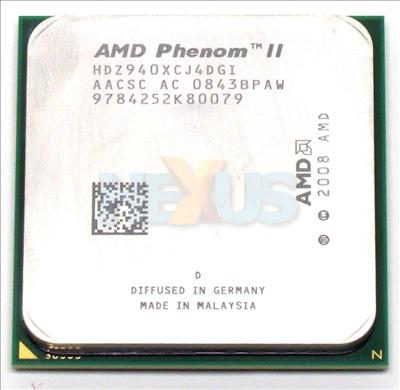
Image of AMD Phenom II from: www.hexus.net

Hexus is a UK based technology-news website that covers a huge array of platforms and hardware. It is an excellent source of information and statistics. This website reviewed and praised one of the newest CPUs from AMD, and I was convinced enough to make a decision that this CPU will be my next upgrade.

I feel this is worth mentioning as my custom built PC is my main tool in the work I do, so it will have to be mentioned in my statement.